How to Mix Patterns Over 50 in Ways That Actually Work

Mixing patterns is the fastest way to make an outfit look interesting — and the fastest way to make it look wrong. Most women over 50 know the fear of “too much” all too well.
This masterclass is for every woman who loves prints but plays it safe. If your closet holds florals, stripes, and a leopard piece you’ve never dared combine, these six rules are for you.
You’ll learn the rules that make any pattern pairing work, see eleven full outfits demonstrating each one, and finish with a beginner’s checklist plus a cheat sheet of mixes that never fail.
A quick foundation first: mixing prints is a skill you build on top of wearing one print well. If you want to start there, our guides on how to wear animal print over 50 and how to wear polka dots over 50 teach you to carry a single pattern with confidence — the skill you’re about to level up.
The Pattern-Mix Rules: A Six-Rule Masterclass
Each rule below states the principle plainly, explains why it works, and shows you complete outfits that prove it. Pick the rule that matches your closet today and start there.
RULE 1 — Share one colour thread. The single most reliable mixing rule: both prints should repeat at least one obvious colour. Colour connects patterns even when the prints themselves have nothing in common.
Why it works: your eye follows the repeated colour like a bridge between the two prints, so the pairing reads as intentional rather than accidental. Navy, brown, or cream are the easiest threads to start with.
1. Navy Florals Meet Fine Pinstripes
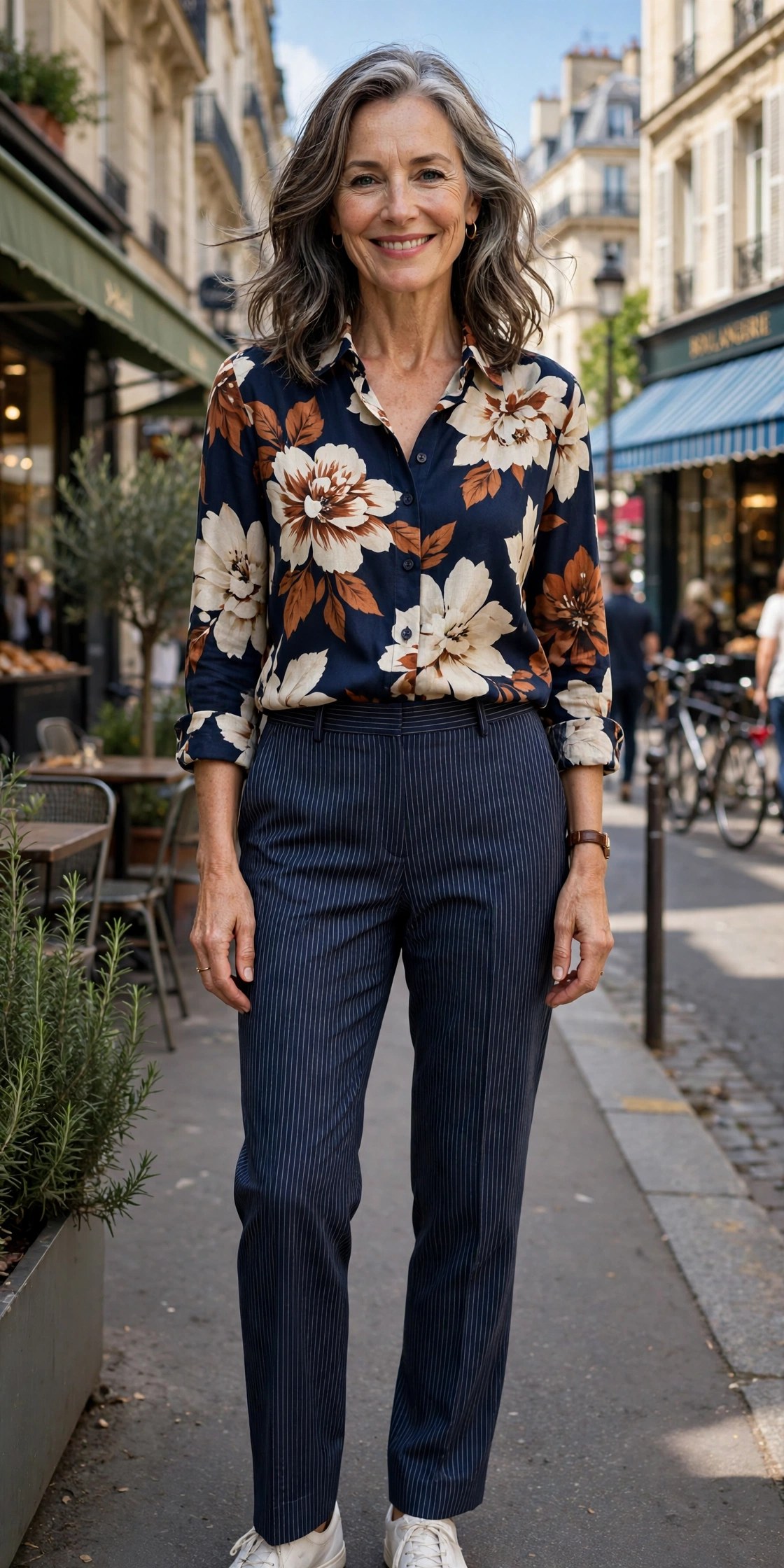
A navy blouse with large-scale florals in cream and rust sits beautifully against fine navy pinstripe trousers. The navy repeats in both pieces, giving the outfit a quiet, polished logic.
Notice the scale contrast too: the blouse print is large and painterly while the stripes are whisper-thin. This pairing is a workday winner — confident, composed, and nowhere near boring.
2. Striped Knit Plus Leopard Flats
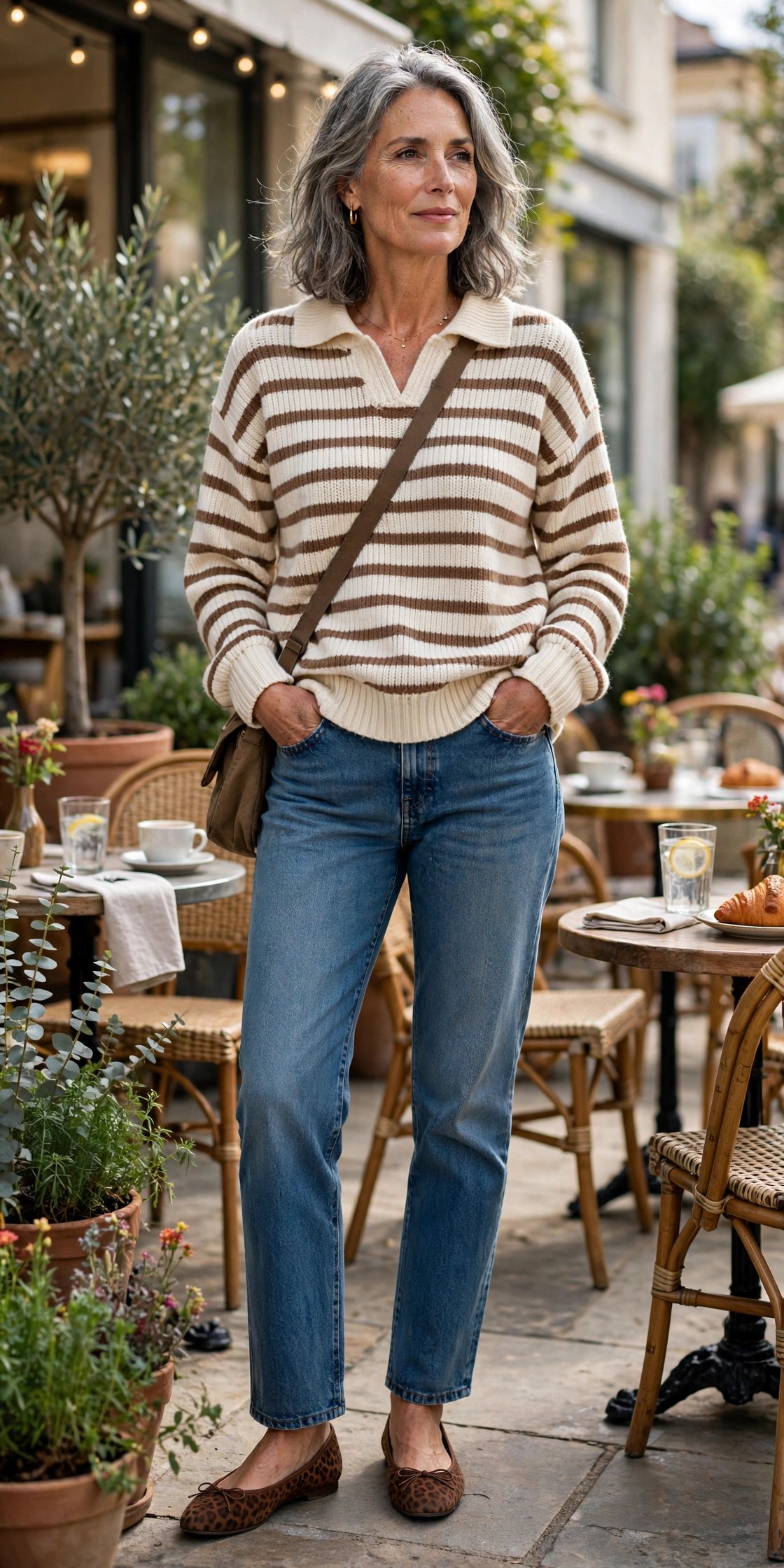
A cream-and-brown striped knit and brown leopard ballet flats are tied together by brown. The jeans between them act as a buffer, so each print gets its own space.
This is the perfect low-stakes first mix. Neither print sits against the other, yet the shared brown makes the whole outfit feel coordinated. Errands have never looked this intentional.
RULE 2 — Contrast the scale. Pair one big print with one small one. When two prints are the same size and strength, they compete; when their sizes differ clearly, they coexist.
Why it works: scale difference creates a visual hierarchy. One print becomes the feature and the other becomes the texture — and the outfit instantly feels designed.
3. Big Botanical, Tiny Check
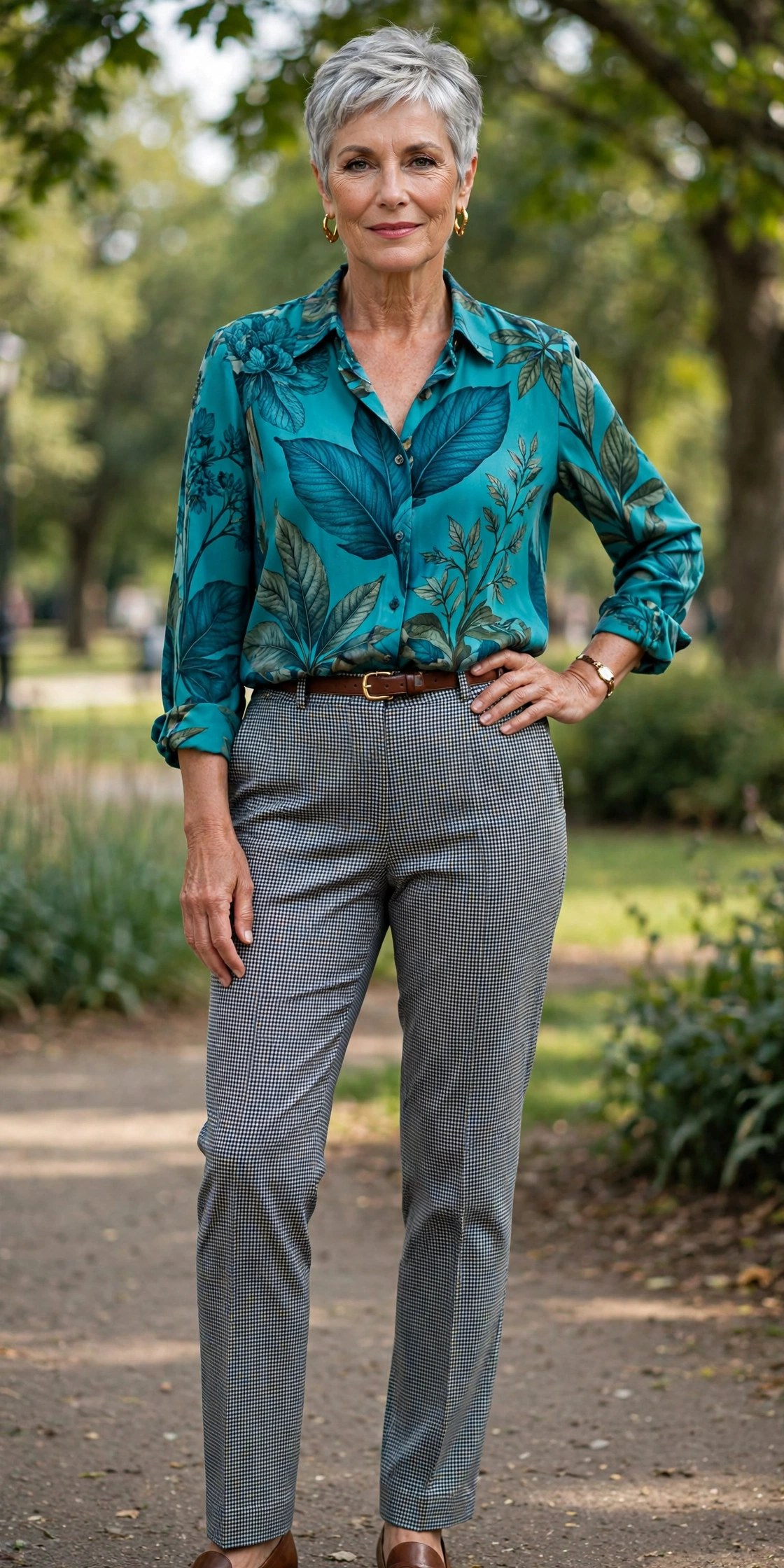
A blouse with a bold, large-scale teal botanical print meets trousers in a tiny micro-check. The difference in print size is dramatic — and that is exactly why it works.
The micro-check reads almost like a solid from a few steps away, letting the botanical print take the spotlight. Think of it as a volume knob: one pattern turned up, the other turned down.
4. Plaid Blazer, Dotted Scarf

A medium-scale brown plaid blazer is grounded by a cream scarf with tiny dots at the neckline. The small dots are the quiet partner to the structured plaid’s authority.
This is a masterclass in proportion: the scarf’s print is small enough that the blazer never feels challenged. A brilliant way to bring pattern into a professional wardrobe.
RULE 3 — Let one print lead. Decide which pattern is the star and let the second one behave like a supporting player. Two prints of equal loudness will always argue.
Why it works: every good outfit has a focal point. When one print clearly leads, the eye knows where to look first, and the result reads as chic rather than chaotic.
5. Bold Geometric Skirt, Quiet Stripe Shirt
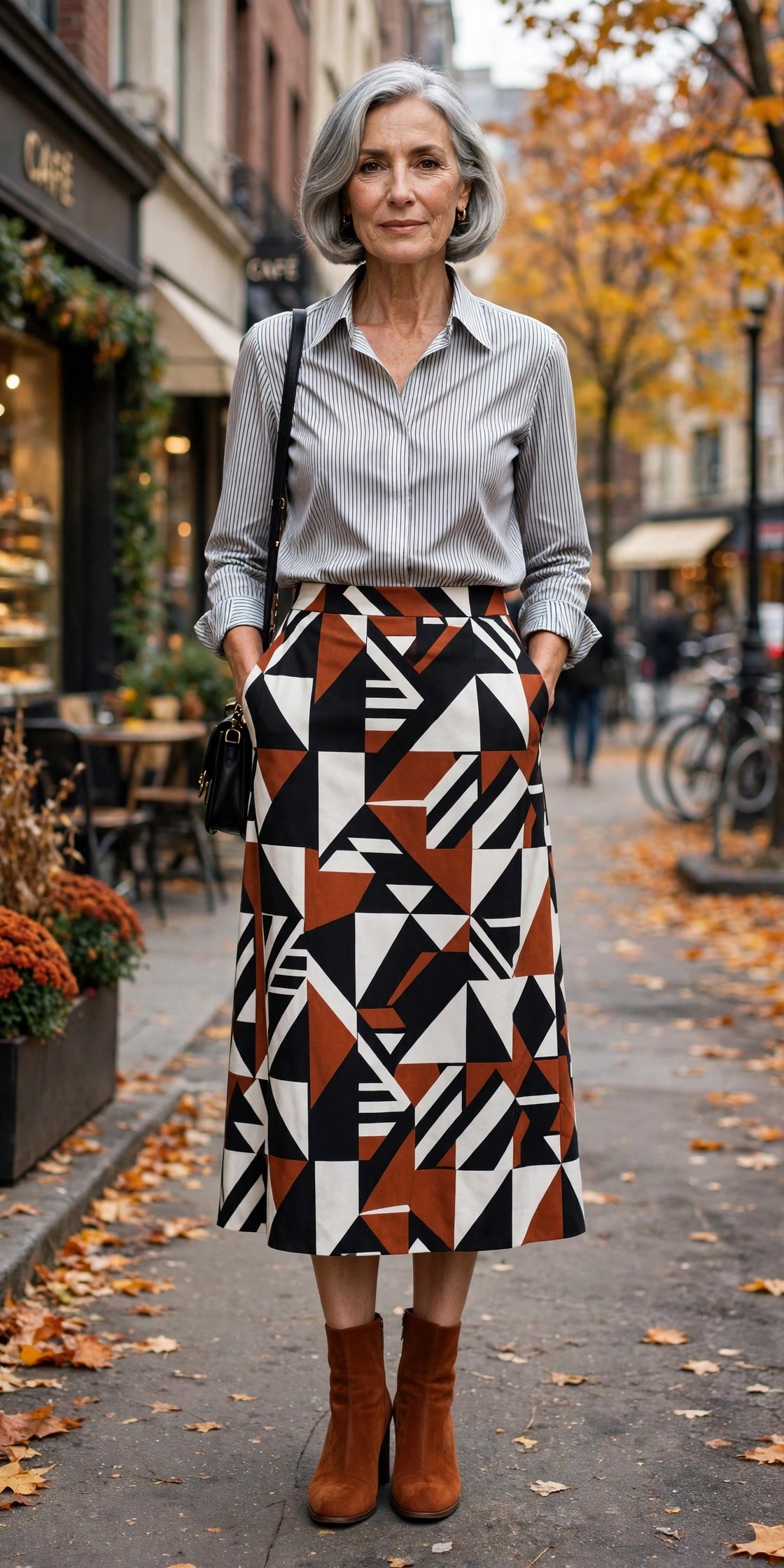
The geometric midi skirt in black, white, and rust is unmistakably the lead here. The pinstripe shirt steps back — same family of tones, but whispered instead of announced.
This outfit proves the one-loud-one-quiet formula. If you ever try a pairing that feels noisy, ask which print is leading; usually the fix is making the quieter one quieter still.
6. Leopard Coat Over Micro Dots

A tan leopard coat is the statement; a cream blouse with micro dots is the support act. The dots are barely there — which is precisely their job.
Leopard over a dot reads as sophisticated rather than showy when the dot stays tiny. Dark jeans and brown boots keep the focus on the coat, exactly where it belongs.
RULE 4 — Stripes are your training wheels. A simple stripe behaves more like a wardrobe basic than a decorative print. Its regular rhythm plays well with florals, checks, dots, paisley, and even leopard.
Why it works: stripes give the eye an orderly structure to hold onto, so the second pattern feels anchored instead of floating. If you are new to mixing, start every experiment with a stripe.
7. Breton Tee and Floral Midi

A classic navy-and-white Breton tee meets a navy-based floral midi skirt. The stripe is familiar and orderly; the floral is romantic and free — and navy holds them together.
This is the combination that convinces skeptics. It looks fresh in a garden, works for a summer lunch, and requires zero courage. Start your mixing journey here.
8. Pinstripe Shirt, Gingham Blazer
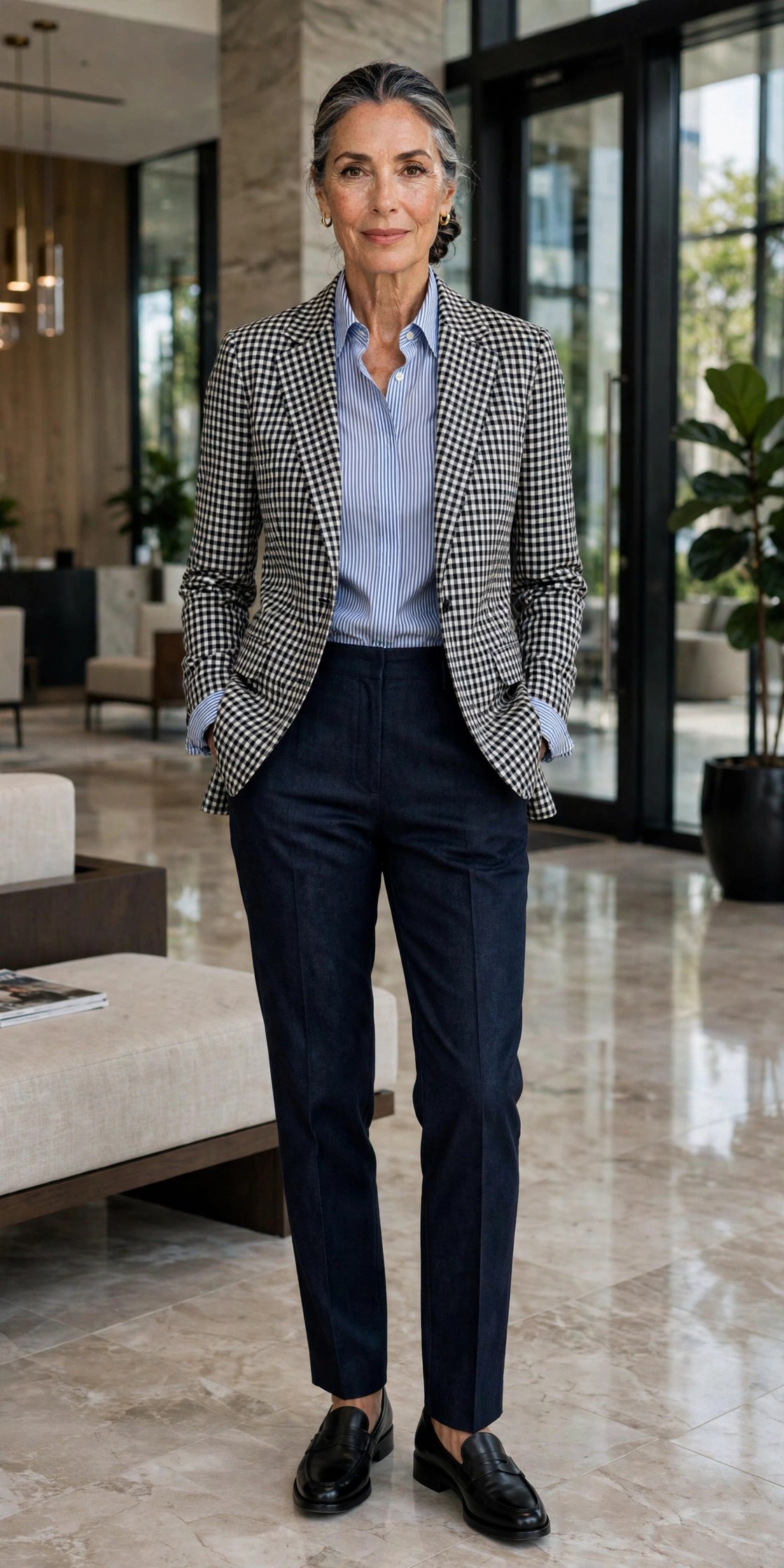
A fine blue-striped shirt under a black-and-white gingham blazer is a double hit of structure. Both prints are orderly, both are restrained, and they agree beautifully.
Stripes plus checks are the office-safe pattern mix. Because both patterns are geometric and low-contrast, the pairing feels sharp rather than playful — proof that stripes truly do pair with almost anything.
RULE 5 — Anchor with a solid. You don’t have to place prints directly against each other. Put a solid blazer, knit, or cardigan between them and the prints stop competing.
Why it works: a solid piece creates breathing room — a visual pause that lets each print be read on its own. When an outfit feels almost right but slightly noisy, the missing ingredient is usually a solid, not fewer prints.
9. Florals and Checks, Anchored by Navy
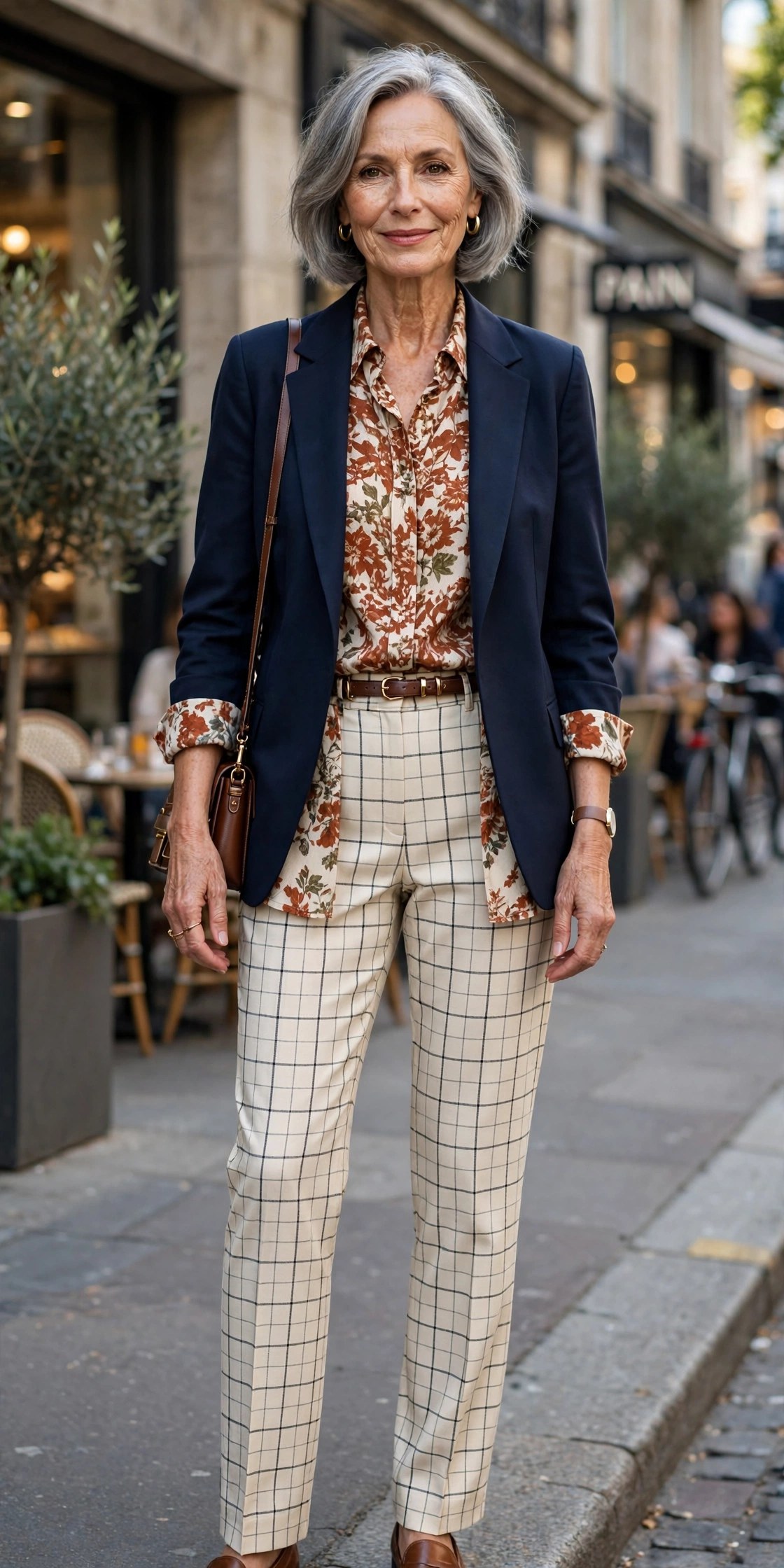
A rust floral blouse and cream windowpane-check trousers would be a lot on their own. A solid navy blazer worn open between them changes everything — it breaks the pattern-on-pattern contact.
The blazer frames the blouse at the neckline and sleeves, so each print reads cleanly. This is the rescue move for any mix that feels one decibel too loud: add a solid layer.
10. Paisley Skirt, Houndstooth Scarf

A teal paisley midi skirt and a black-and-white houndstooth scarf are two strong patterns — but they never touch. A plain cream knit sits between them as a calm buffer zone.
This is the distant-mix technique: patterns placed at the neck and the hem, with a solid in between. You get all the personality of two prints with none of the noise.
RULE 6 — Keep the silhouette simple. When prints are doing the talking, let the shapes stay quiet. Straight trousers, uncomplicated tops, and clean skirts give the patterns room to work.
Why it works: an outfit has a limited budget of visual movement. Two prints spend most of it; fussy shapes would overspend. Simple cuts also flatter — the prints draw the eye, and clean lines do the rest.
11. Floral Top, Striped Trousers — The Clean-Line Combo

A small navy floral top with straight navy-and-white striped trousers shows the final rule in action: both patterns are present and lively, but the shapes couldn’t be simpler.
A tucked-in top, straight-leg trousers, solid loafers — nothing competes with the prints. This is the everyday uniform of a confident pattern mixer: interesting prints, effortless shapes.
Your First Mix: The Beginner’s Checklist
Ready to try? Work through this checklist in front of your mirror.
- Pick the print you want to feature — your lead pattern.
- Choose a quieter second pattern that shares one colour with the first.
- Check the scale: is one print clearly bigger than the other?
- Put distance between them — a solid top, blazer, jeans, or shoes.
- Keep the shapes simple; let the prints be the stars.
- Stand back and squint: if the mix still feels busy, make the quiet print quieter or swap it for a stripe.
Mixes That Always Work: The Cheat Sheet
Save this list. Every one of these combinations follows the rules above and has been proven on real closets.
- Navy floral + fine pinstripe — share navy, contrast scale.
- Breton stripe + any floral — the stripe is the neutral.
- Leopard + micro dots — one loud, one whisper-quiet.
- Plaid blazer + tiny-dot scarf — structured meets subtle.
- Paisley skirt + houndstooth scarf + cream knit — two prints, one solid buffer.
- Any two prints + a solid blazer between them — the universal rescue move.
Frequently Asked Questions
Can you wear three patterns at once over 50?
You can, but two is the sweet spot. If you try three, make one of them very small — a printed scarf or shoes — and anchor the rest with a solid.
What is the easiest pattern combination for a beginner?
Stripes plus florals. A Breton tee with a floral skirt or scarf almost always works, especially when the two pieces share one colour like navy or black.
Do the pattern colours need to match exactly?
No — they just need to echo. A print’s navy doesn’t have to be identical to the other’s; it only needs to read as the same colour family from a few steps away.
Can stripes really go with anything?
Nearly. Fine stripes pair with florals, checks, dots, paisley, gingham, and even leopard. Just keep the stripe simple — chunky graphic stripes are a different story.
Are there patterns that don’t mix well together?
Two large, high-contrast prints in unrelated colours are the hardest mix. If you love both, add a solid layer between them or repeat one colour through a belt or shoes.
Pattern mixing is a skill, not a talent — and now you know the rules. Try one pairing from the cheat sheet this week, then build your own combinations using the checklist.
Your prints were meant to meet. Let them.