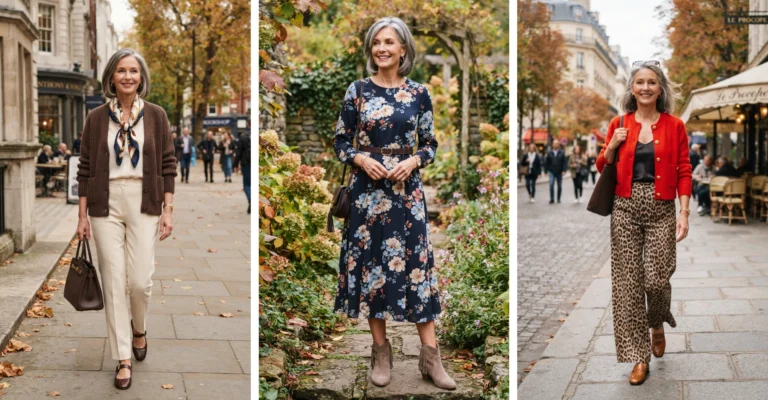
How to Find Your Color Season After 50 — Even With Grey Hair
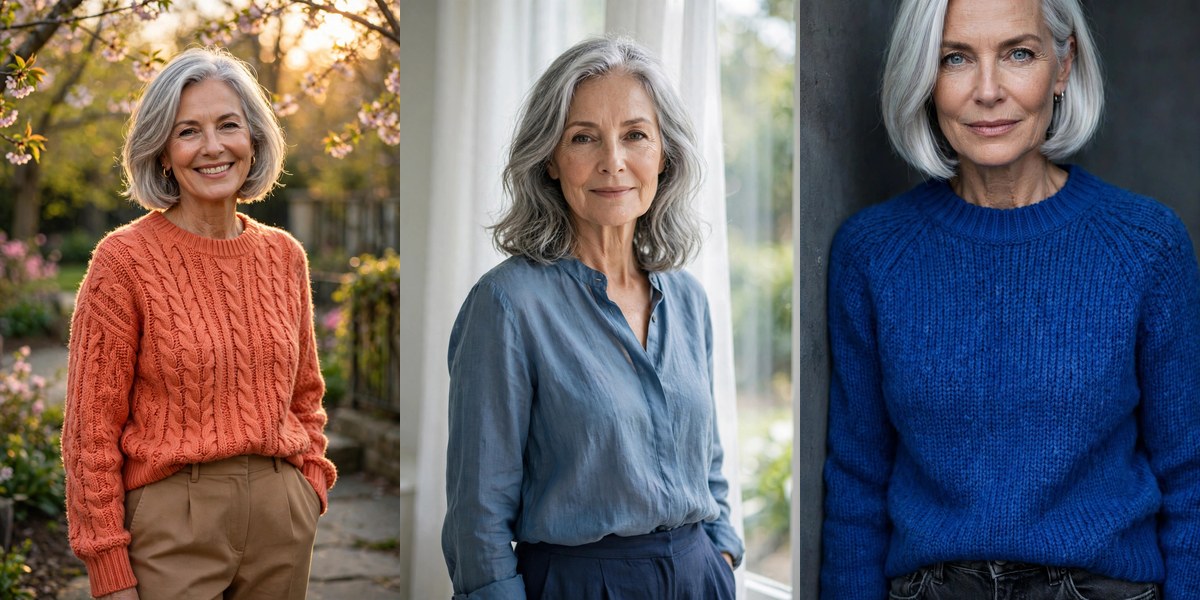
Your color season did not retire when your hair turned silver. It simply needs a small update — and you can find it yourself, in daylight, in about twenty minutes.
This guide is for women over 50 with grey, silver, salt-and-pepper, or newly white hair whose old color rules suddenly feel “off.” You will run four simple at-home tests, match your result to one of the four seasons, and then learn the grey-hair adjustments that make each season work for you now. If you want the finished color combinations first, our sister guide on the best colors to wear with grey hair after 50 pairs beautifully with this one.
By the end, you will have a personal palette card — a small, carryable list of your best neutrals, colors, and accents — built from your own mirror, not a label someone pinned on you in a department store in 1998.
Part One: The Four-Test Self-Analysis
Seasonal color analysis sounds technical, but it answers only three questions about your face: is it warmer or cooler, lighter or deeper, clearer or softer? Run each test in daylight, with a bare face, and look at your face — not the fabric. That is the whole secret.
1. Test One: The Drape Test — Warm or Cool?

Hold two light neutrals beside your neck: an ivory or cream knit on one side, a crisp pure-white cotton on the other. One of them will make your skin look even and your eyes look clearer. The other will add shadows, redness, or a slightly sallow cast. That reaction is your answer, not a theory.
If cream wins, you lean warm. If crisp white wins, you lean cool. Repeat with a second pair — coral versus raspberry, or camel versus cool grey — and notice whether the pattern holds. Honest limit: indoor yellow bulbs can make everything look warm, so always retest by a window if the result surprises you.
2. Test Two: The Depth Test — Light or Deep?

Drape something light (ivory sweater) over one shoulder and something deep (charcoal top) over the other. Ask a friend — or your camera — which side looks more balanced. Light-leaning faces look fresher when darkness stops at medium depth; deep-leaning faces look anchored, not tired, in stronger color.
Grey hair often shifts this answer lighter than it used to be, because silver hair adds so much brightness near the face. If your old deep palette now feels heavy, you have not lost your season — you have moved toward the lighter end of it. Navy and denim blue are excellent “middle” references when you feel stuck between answers.
3. Test Three: The Brightness Test — Clear or Soft?

Compare a clear, saturated color (cobalt blue, bright turquoise) with a softened one (dusty blue, sage). Watch what arrives first: if the fabric announces itself before you do, it is probably too bright; if your face looks tired and disappears beside the color, it is probably too muted.
Silver hair often makes softened colors feel more connected to the face — but not always. Bright-silver hair paired with clear, bright eyes can look spectacular in clean, vivid color. Be honest about what can and cannot settle here: this is the one test worth repeating on two different days before you trust it.
4. Test Four: The Contrast Check — Your Photo in Black and White

Take a selfie in natural light, convert it to black and white, and look at the difference between your hair, brows, eyes, and skin. White hair with darker brows and clear eyes is still high contrast. Silver hair with light brows and softly blended features reads low contrast. Neither is better — they just shop differently.
High-contrast faces can carry sharper combinations like navy with white or charcoal with raspberry. Low-contrast faces usually look more harmonious in blended pairings — dusty blue with mushroom, soft navy with muted rose. This test matters more after 50 than it ever did, because grey hair changes your contrast even when nothing else moves.
Part Two: Your Season Chapters
You now have three answers — warm/cool, light/deep, clear/soft. Each combination points to a season family. Here is what each one means in practice, the grey-hair adjustment that keeps it working, and one sample outfit palette to try first.
5. Spring: Warm, Clear, Light
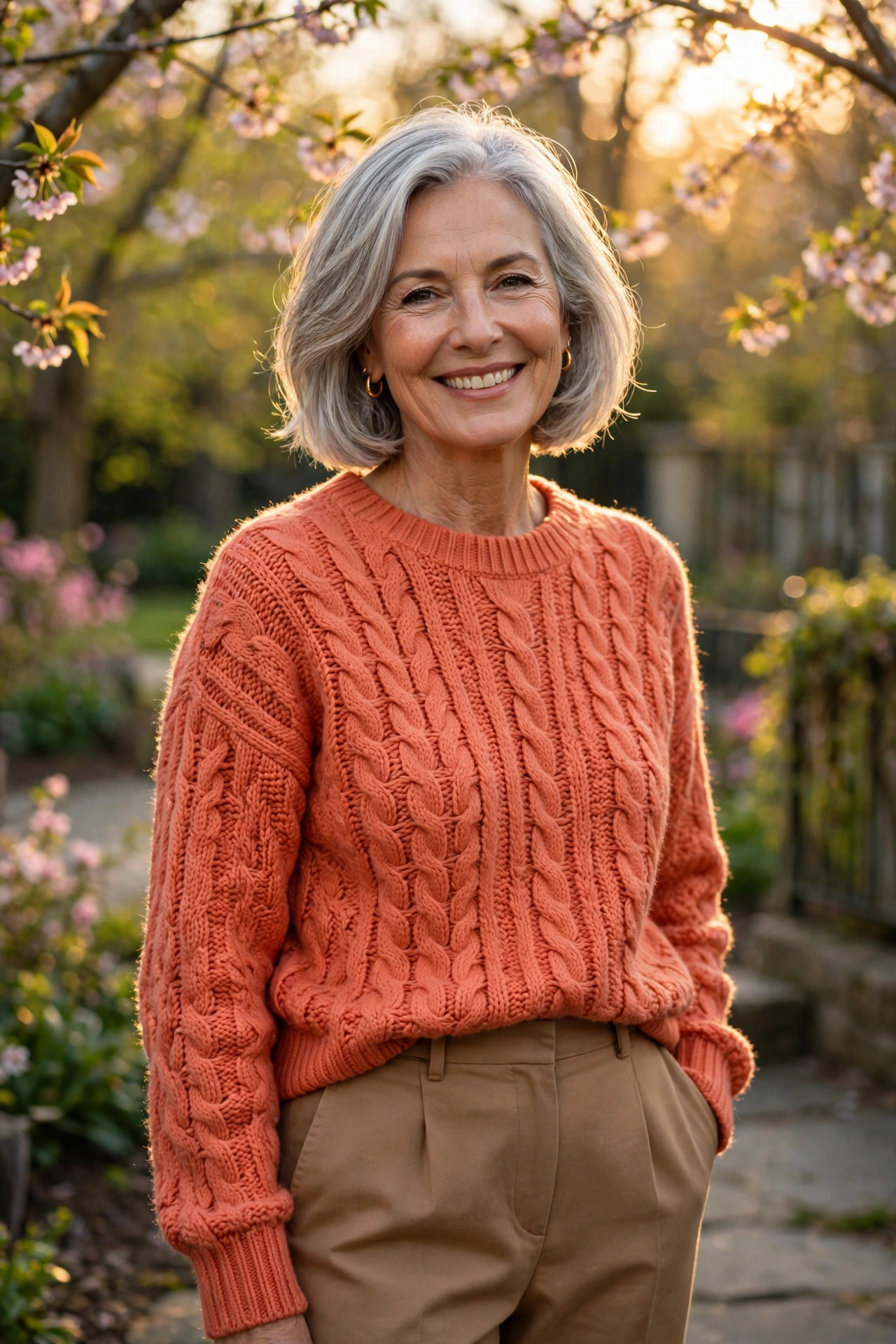
Spring is warm, bright, and light-to-medium in depth. If your tests came out warm, light, and clear, this is your family: fresh, lively colors like coral, warm turquoise, leaf green, and cream that look sunlit rather than heavy.
The grey-hair adjustment: silver hair gently softens Spring’s brightness, so swap anything neon-adjacent for its clear-but-softened cousin — coral becomes warm peach, kelly green becomes leaf green. Keep cream over pure white near your face. Sample palette: ivory knit, coral scarf, camel trousers, gold jewelry.
6. Summer: Cool, Soft, Light

Summer is cool, soft, and light. This is where many grey-haired women land: dusty blue, mauve, soft navy, and muted berry that whisper instead of shout. If your drapes kept choosing cool, soft, and light, you are home.
The grey-hair adjustment: bright-silver hair can push Summer toward Winter’s clarity, which is good news — borrow one clear color, like raspberry, as an accent. That single sharper note keeps soft palettes from reading sleepy. Sample palette: dusty-blue blouse, soft-navy trousers, pewter cardigan, silver jewelry.
7. Autumn: Warm, Soft, Deep

Autumn is warm, soft, and deep: olive, rust, teal, camel, and warm burgundy. Warm-toned women keep their season when their hair goes silver — the warmth lives in your skin, and the hair never got a vote.
The grey-hair adjustment: lighten the deepest end of your old Autumn wardrobe. Charcoal becomes warm grey, chocolate becomes camel, and you keep the rusts and teals exactly where they are. If you love silk, this is its natural home — see how to wear silk over 50 for pieces that carry these tones beautifully. Sample palette: rust cardigan, olive tee, camel trousers, gold jewelry.
8. Winter: Cool, Clear, Bold

Winter is cool, clear, and deep: cobalt, cranberry, charcoal, crisp white, icy pink. Bright-silver hair with clear eyes is Winter’s dream combination — striking, graphic, unforgettable. If you loved strong color at 40, you may still love it at 60.
The grey-hair adjustment is minimal, and that is the point: you can still wear black. If black starts feeling severe at the neckline, try charcoal, navy, or an open collar that puts a little skin between the color and your face. Sample palette: charcoal jeans, cobalt sweater, cranberry lipstick, silver jewelry.
Part Three: Make It Yours
9. The Grey-Hair Translation: Three Shifts Silver Makes

First shift: contrast usually drops. Whatever season you land in, move your neutrals near the face one step lighter — charcoal instead of black, soft navy instead of midnight. Second shift: warmth leaves the frame. Warm seasons should keep their warmest, brightest accents at the neckline and ears, where they replace what the hair used to do.
Third shift: your hair becomes an accessory. Treat silver like a neutral you never have to buy — it pairs with everything, so stop trying to match it and start dressing around it. This single mindset change does more for a wardrobe than any shopping spree.
10. Six Mistakes That Ruin a DIY Color Test
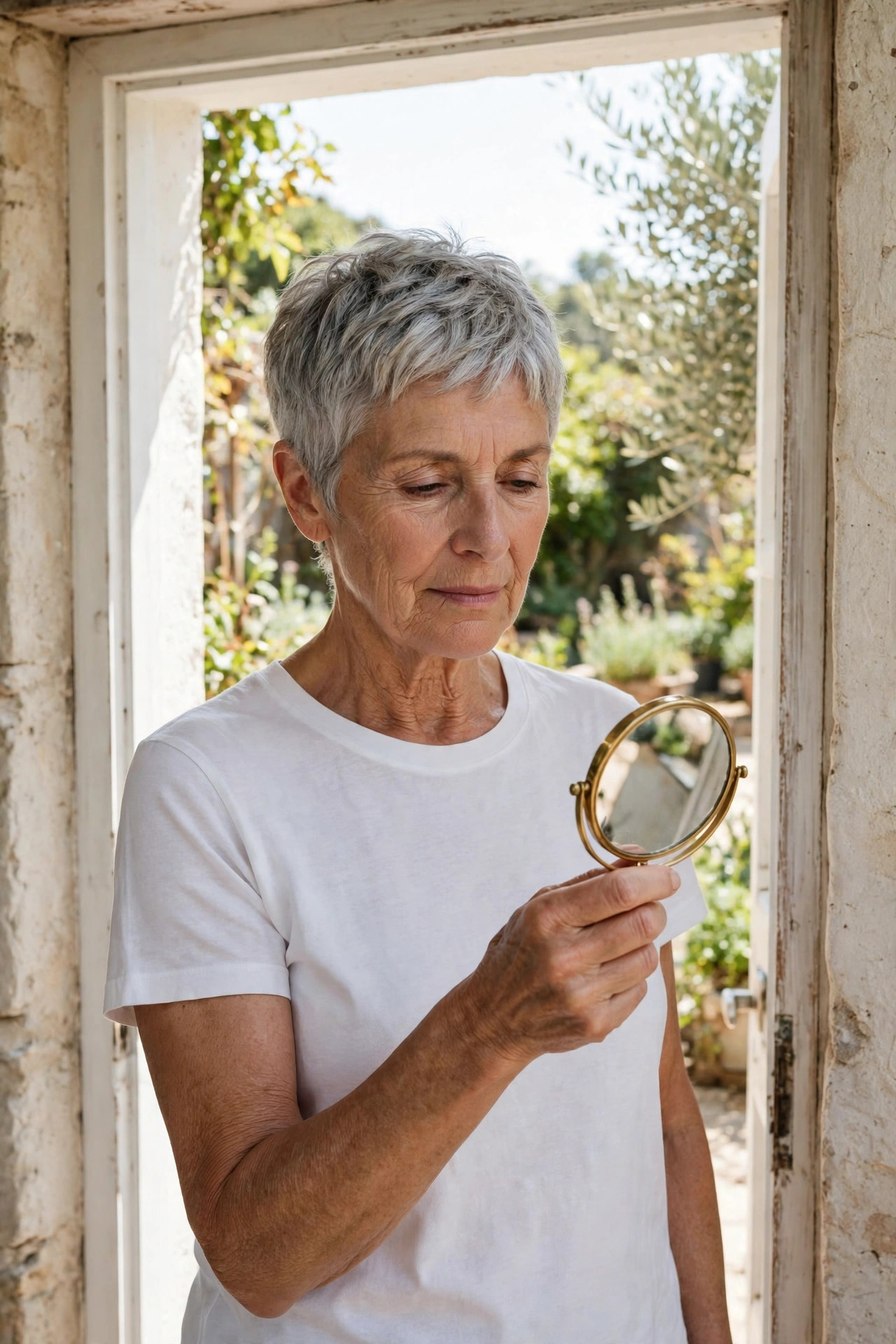
These are the errors that make people mistype themselves. Avoid them and a home test is genuinely useful.
- Testing under warm bathroom lights. Move beside a window in daylight; yellow bulbs make nearly every color look warmer than it is.
- Wearing full makeup. Strong blush, bronzer, or lipstick can make unsuitable colors look harmonious and hide what your bare skin is telling you.
- Judging the hair instead of the face. Watch your eyes, skin clarity, and shadows — the fabric is there to reveal your face, not to match your hair.
- Testing one swatch alone. Always compare pairs — cream versus white, muted versus clear — so you can see an actual difference.
- Testing at night or exhausted. Tired skin flatters nothing. Retest in the morning before you finalize anything.
- Deciding after one round. Do each test twice, on different days. Patterns, not single moments, give you the answer.
11. Build Your Personal Palette Card
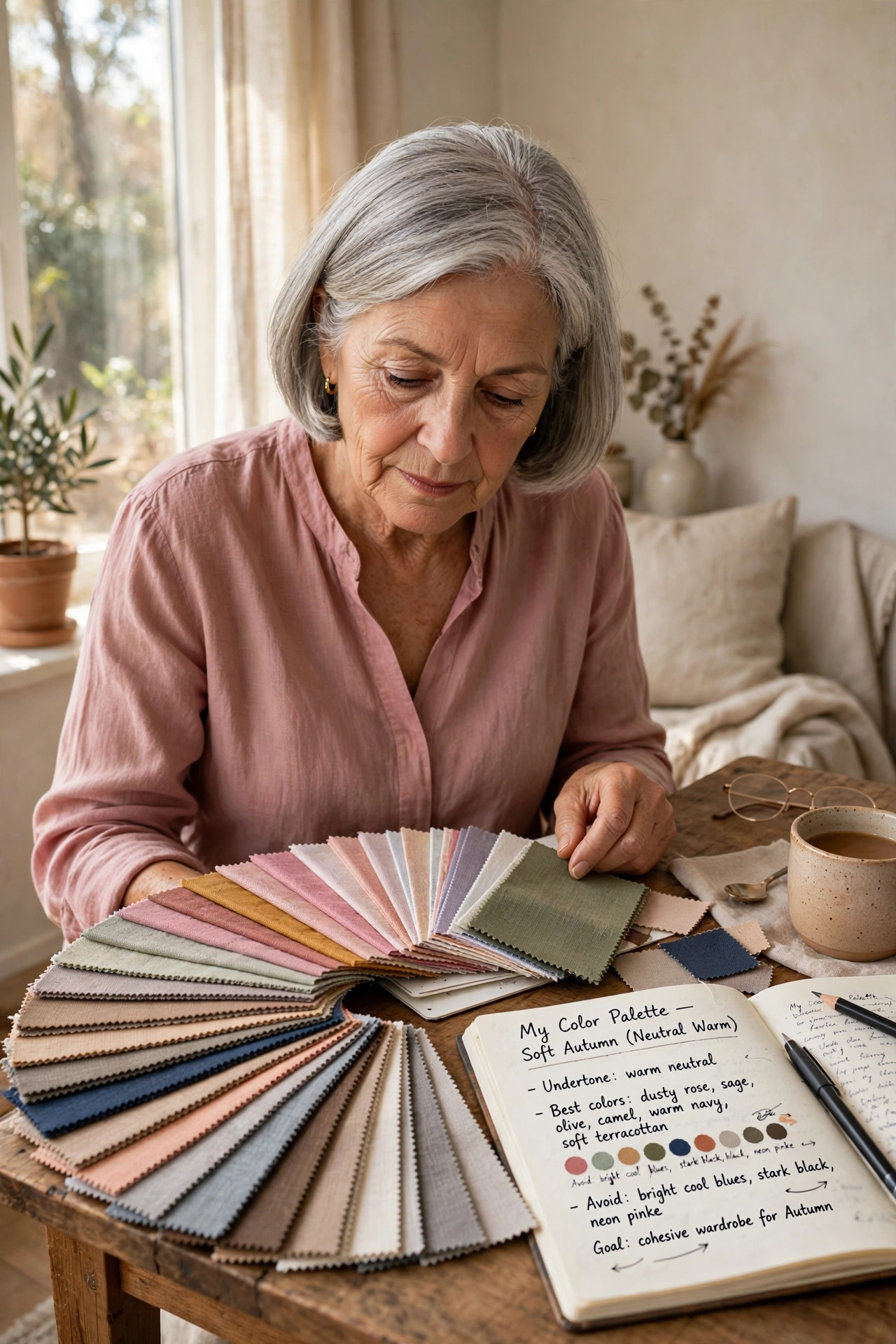
Turn your three test answers into a carryable card: two neutrals, three everyday colors, one stronger accent, one metal direction. Write it on an index card and keep it in your bag. Example: soft navy + ivory, dusty blue + teal + mauve, raspberry accent, silver jewelry.
Do not purge your wardrobe because half of it falls outside the card. Wear your most supportive colors at the neckline and keep beloved-but-tricky shades in trousers, shoes, bags, and prints — that protects cost-per-wear beautifully. If you shop on a budget, quiet luxury on a budget shows how a tight, repeated palette makes inexpensive pieces look expensive.
12. Your Self-Test Toolkit (Checklist)
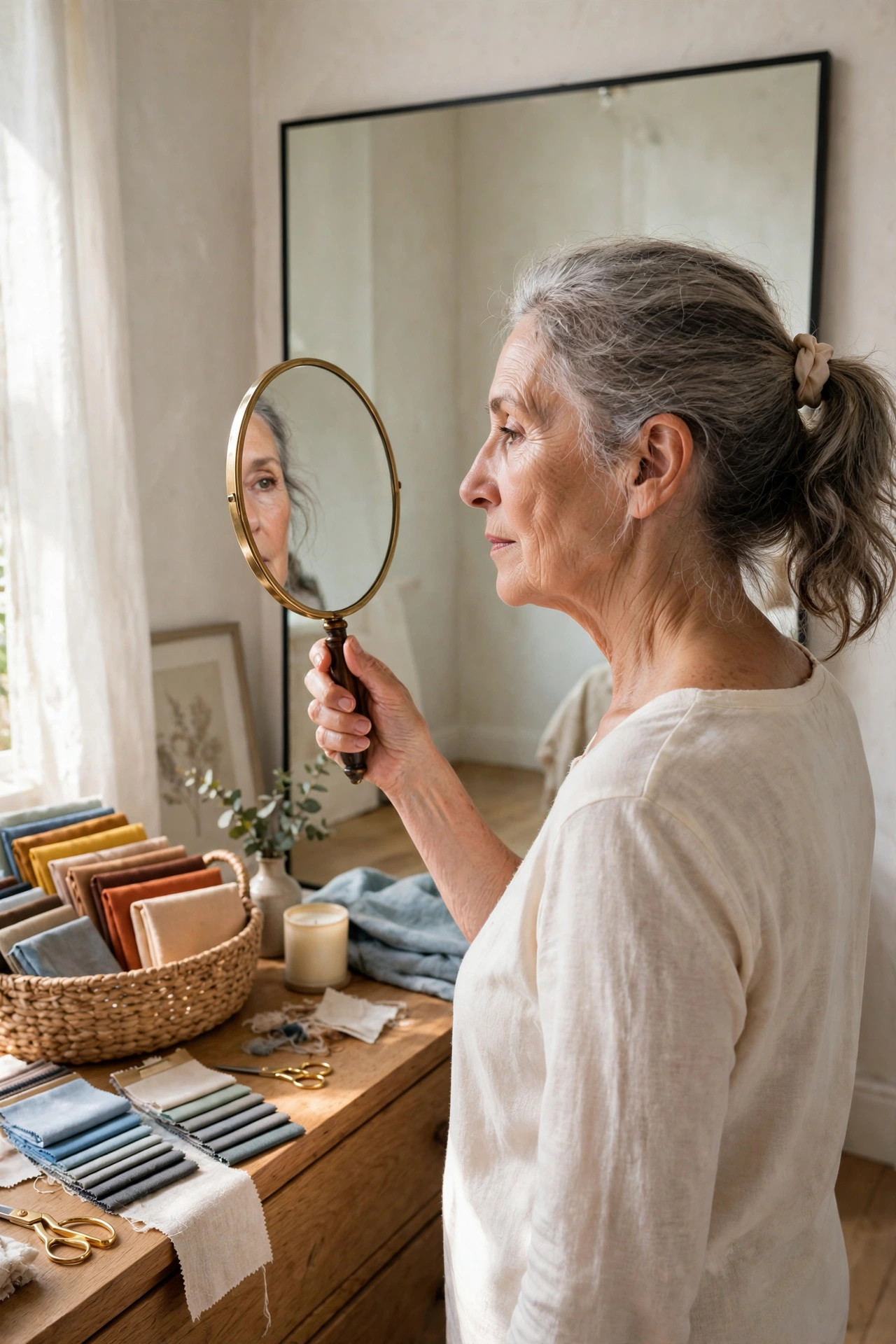
Gather these before you start and the tests take under half an hour. Tick them off as you go:
- A window or bright doorway — daylight is the only light that does not lie
- A bare face, no foundation, blush, or bronzer
- Two white tees: one crisp white, one ivory or cream
- A handheld mirror you can angle
- Four to six fabric pieces in warm/cool pairs (coral vs raspberry, camel vs cool grey, olive vs blue-green)
- Your phone camera, for the black-and-white contrast check
- An open-neck top, so you can retest any dark shade that felt harsh
- One honest morning — rested skin, no events that day
Frequently Asked Questions
Does grey hair automatically make me a cool color season?
No. Silver hair can look warm or cool, but your skin undertone decides the temperature question. Warm-toned women with grey hair can still belong to Spring or Autumn families, and the drape test in this guide will prove it in about two minutes.
Can my color season change as I get older?
Your undertone rarely flips completely, but your best versions of your colors can shift. Lower contrast or lighter silver hair usually means slightly softer, lighter, less severe shades feel more balanced than the ones you loved at 40.
What if I fall between two seasons?
That is normal — real faces do not fit four neat boxes. “Mostly Summer with a few Winter colors” is a more useful answer than a forced label, and your personal palette card is built to hold exactly that kind of hybrid result.
Is black still flattering with grey hair?
It can be. Bright-white or silver hair with clear eyes can look striking in black, while softer coloring usually feels more balanced in charcoal, navy, or deep grey. If black feels severe, open the neckline or add a scarf between the color and your face.
How do I know if my self-test results are right?
Re-run each test twice on different days and look for a consistent pattern rather than one dramatic result. If you keep landing between the same two seasons, you probably are — and shopping from that hybrid zone works perfectly well.
Your season is not a verdict; it is a starting point that makes every future shopping trip easier. Run the tests, build the card, and let your silver hair do what it does best — set off every color you choose.