
The Simple Hair Care Routine Every Woman Over 50 Should Follow
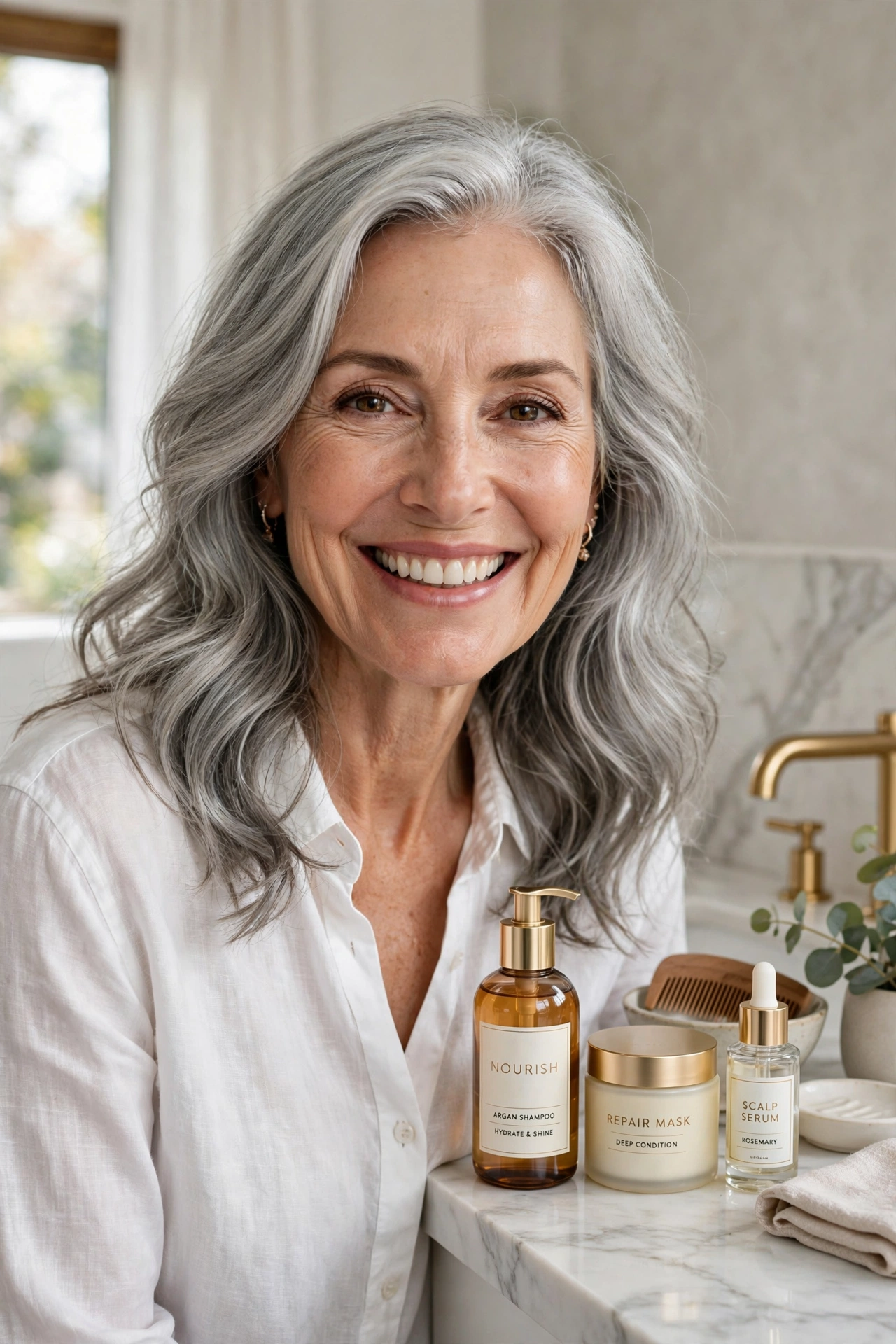
After 50, hair changes the rules on you. The shampoo that worked for twenty years suddenly leaves your hair flat or frizzy. Your scalp gets drier, your texture shifts, and grays have opinions of their own. If your old routine isn’t cutting it anymore, here’s the hair care routine for women over 50 that actually works with aging hair instead of fighting it.
I spent years overcomplicating this — a dozen products, endless tutorials. Then my stylist said something that stuck: “Your hair needs less, done right.” She was right. This routine has six simple parts, and none of them take more than a few minutes.
Step 1: Cleanse Gently (and Less Often) 🧴
Most women over 50 are washing too much. Shampoo strips the natural oils your scalp now produces in smaller amounts, leaving hair dry and brittle. Two to three times a week is plenty for most hair types. When you do wash, use a sulfate-free shampoo and focus it on the scalp — massage with your fingertips, not your nails, and let the rinse carry the suds through your lengths. That’s all the cleansing your ends need.
Samantha’s note: If your scalp gets oily fast, try a dry shampoo on day two instead of reaching for the shower. Your ends will thank you.
Step 2: Condition Like You Mean It
Conditioner is no longer optional — it’s the main event. After 50, hair is more porous and loses moisture fast, so apply conditioner from mid-length to ends every single wash, and leave it on for a full two to three minutes. I set a little timer on my phone at first until it became habit. For very dry or coarse hair, try conditioning twice: once before shampoo (yes, really) and once after. It sounds odd, but it protects your lengths from the shampoo’s stripping.
Step 3: Treat Weekly — Your Hair’s Standing Appointment
Once a week, give your hair a proper treatment. A deep conditioning mask, a hot oil treatment, or even just coconut oil on the ends for 20 minutes before washing. Pick a Sunday evening, put on a shower cap, and let it work while you read or watch something. This is the single step that transformed my hair from “fine, I guess” to genuinely soft. Consistency beats fancy products every time — a drugstore mask used weekly outperforms a luxury one used monthly.
Step 4: Style With a Light Hand ✨
Heavy styling products and high heat are harder on mature hair, which is finer and more fragile than it used to be. Embrace lighter formulas: a pea-sized amount of serum on damp ends, a root-lifting mousse if you need volume, and always — always — a heat protectant before any hot tool. Turn your dryer and straightener down a notch; you don’t need maximum heat anymore, and your hair will hold style just fine at lower temperatures. Air-drying halfway before blow-drying also cuts heat exposure dramatically.
Step 5: Protect It While You Sleep 🌙
Cotton pillowcases create friction that roughs up the hair cuticle overnight, leading to frizz and breakage by morning. A silk or satin pillowcase is one of the cheapest upgrades with the biggest payoff — your hair slides instead of snagging. If your hair is long enough, loosely braid it or twist it into a low bun before bed. I resisted the silk pillowcase for years thinking it was a luxury. It is. It’s also the best eight dollars I’ve spent on my hair.
Step 6: Feed It From the Inside 🥑
Hair is built from what you eat, and after 50, protein and iron intake often quietly drops. Aim for protein at every meal — eggs, fish, beans, Greek yogurt — and don’t fear healthy fats: avocados, nuts, and olive oil keep both scalp and strands supple. If your hair is thinning noticeably, ask your doctor to check your iron and vitamin D levels before buying any supplement. Sometimes the fix is in your bloodwork, not your bathroom.
Step 7: Get Regular Trims (Yes, Even Growing It Out)
This feels counterintuitive, but skipping trims is why so many women over 50 end up with thin, straggly ends. Split ends travel upward, breaking hair faster than it grows. A small trim every 8 to 10 weeks keeps ends thick and healthy, which makes all your hair look fuller. Tell your stylist you want a “dusting” — just the very tips — if you’re growing it out. Healthy ends are the whole game.
You don’t need to overhaul everything tomorrow. Start with the step that addresses your biggest frustration — dryness, breakage, flatness — and add the rest one at a time. In a month, your hair will feel different. In three months, other people will notice. And the best part? Once it’s a routine, it stops feeling like work and just becomes how you take care of yourself. You deserve that.



16 Comments